Introduction
Selecting the correct company structure is one of the most important decisions when establishing a business in Switzerland. For international founders—particularly those from Eastern Europe and Asia—the choice often comes down to AG (Aktiengesellschaft) or GmbH (Gesellschaft mit beschränkter Haftung).
Both structures offer strong legal protection, excellent reputation, and access to Switzerland’s stable business environment.
However, they differ significantly in terms of capital requirements, privacy, investor perception, and suitability for high-growth or cross-border businesses.
This guide explains the differences in depth and helps you determine which structure is best for your business.
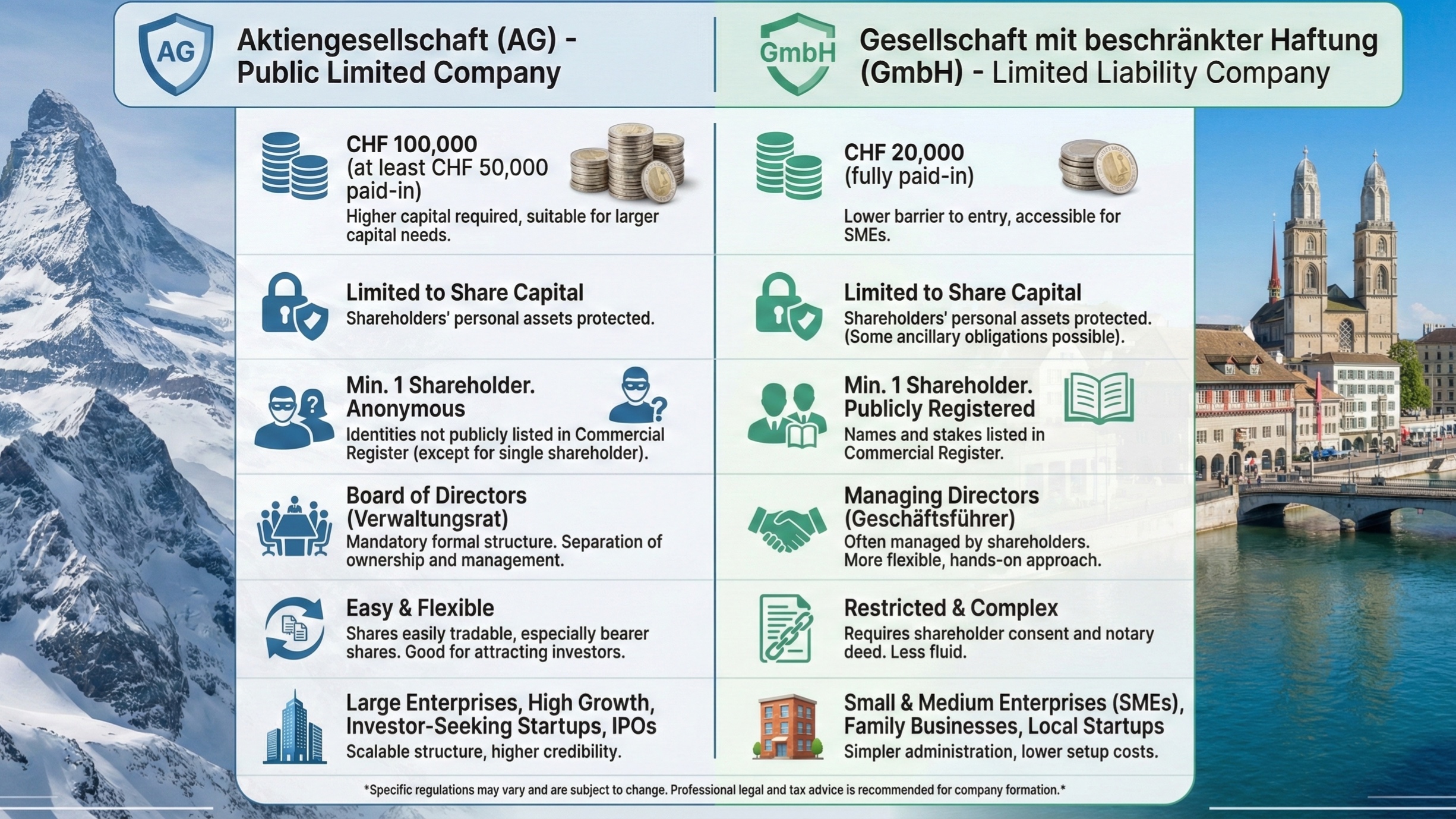
1. Quick Comparison: AG vs GmbH
Feature | AG | GmbH |
|---|---|---|
Minimum Share Capital | CHF 100,000 (CHF 50,000 paid-in) | CHF 20,000 (fully paid-in) |
Shareholder Privacy | High (anonymous) | Low (names publicly listed) |
Suitable For | Larger businesses, holdings, international investors, regulated industries | SMEs, freelancers, small to medium foreign businesses |
Reputation | Highest corporate prestige | Reliable but less prestigious |
Transfer of Shares | Easy, no notary required | Requires notary |
Governance | Board of Directors required | One or more managing directors |
2. AG Switzerland: Best for International, High-Growth, and High-Risk Businesses
An AG is Switzerland’s most prestigious and internationally recognized legal structure. It is the preferred choice for:
Holding companies
Private equity and investment structures
Regulated businesses (PSPs, fintech, finance-related)
Companies needing external investors
Businesses operating globally with complex cross-border flows
Key Advantages of the AG
2.1 Strong Shareholder Privacy (Major Advantage for Foreign Founders)
Unlike GmbH, the shareholders of an AG remain private.
Only the board members are publicly listed in the Swiss commercial register.
This is important for:
Founders operating in sensitive markets
Executives who prefer anonymity
High-net-worth individuals
Structuring holdings to protect ownership visibility
Privacy matters—especially for entrepreneurs from Eastern Europe, CIS, Asia, and the Middle East.
2.2 Easier Transfer of Shares
Shares in an AG can be transferred without a notary.
This makes the AG ideal if you plan to:
Attract investors
Sell equity
Exit in the future
Distribute ownership across jurisdictions
2.3 Best Structure for Swiss Holding Companies
AGs are the standard for holding companies benefiting from:
Nearly 0% tax on capital gains (participation exemption)
Reduced taxation on dividends
Strong global recognition
If you want a Swiss holding structure, AG is the only serious choice.
2.4 Higher Corporate Reputation
Banks, investors, and government institutions view AGs as:
More mature
More stable
More trustworthy
This matters especially when opening Swiss bank accounts or onboarding with payment providers (PSPs).
Disadvantages of the AG
Higher capital requirement
Additional governance formalities
Slightly more expensive formation
Requires at least one board member residing in Switzerland
3. GmbH Switzerland: Best for Smaller Foreign-Owned Businesses
A GmbH is Switzerland’s most common SME structure and a good fit for:
Small foreign-owned service companies
IT freelancers and developers
Consultants
E-commerce operators with modest turnover
Entrepreneurs starting their first Swiss legal entity
Key Advantages of the GmbH
3.1 Lower Capital Requirement
GmbH requires CHF 20,000, fully paid in.
This makes it accessible for smaller operations and early-stage companies.
3.2 Simple Management Structure
A GmbH can be managed by one person.
You do not need a full board of directors.
3.3 Suited for Small Teams and Local Operations
If your business is not planning to raise external investment and remains small, a GmbH is efficient and economical.
Disadvantages of the GmbH
3.4 No Shareholder Privacy
All shareholders appear publicly in the Swiss commercial register.
This is often a dealbreaker for international founders who want discretion.
3.5 Not Ideal for Investors or Corporate Structuring
Equity transfers require a notary.
This discourages:
Venture capital
Private equity
International investors
Corporate restructuring
3.6 Lower Reputation Compared to AG
While still trusted, a GmbH is seen as a smaller, simpler entity.
Banks sometimes scrutinize GmbHs more heavily—especially for non-resident owners.
4. Which Structure Should International Founders Choose?
If you are a foreign entrepreneur choosing between AG and GmbH, here is the rule of thumb:
Choose an AG if:
You want strong privacy
You plan to raise capital or add partners
You need credibility with banks or financial institutions
You are building a holding company
Your operations are high-risk (PSP, trading, fintech, crypto, cross-border commerce)
You want maximum flexibility for the future
The AG is the structure used by most international founders, global businesses, and investors.
Choose a GmbH if:
You want a simple, low-cost setup
You operate a small service business
You do not need investors
Privacy is not a concern
You want the easiest structure for day-to-day management
It is perfect for freelancers, IT professionals, consultants, and e-commerce owners.
5. Tax Differences Between AG and GmbH
There are no major tax differences between AG and GmbH.
Both are taxed identically at:
Federal level
Cantonal level
Communal level
The key tax optimization lever is not the structure, but the canton (Zug, Nidwalden, Schwyz are the most efficient).
6. Bank Account Opening: AG Has a Clear Advantage
Swiss banks assess companies based on:
Governance
Compliance documentation
Business model
Risk profile
Corporate reputation
AGs are seen as lower risk and more transparent in governance, making bank account approval generally smoother for:
Non-resident shareholders
Eastern European founders
Asian founders
Cross-border operational companies
High-risk industries
7. Formation Requirements: AG vs GmbH
Requirement | AG | GmbH |
|---|---|---|
Min. Capital | CHF 100,000 | CHF 20,000 |
Swiss Address | Required | Required |
Swiss Resident Director | Required | Required |
Formation Time | 1–3 weeks | 1–3 weeks |
Liability | Limited | Limited |
Governance | Board of Directors | Managing Directors |
8. Step-by-Step Process to Choose the Right Structure
1. Define your growth plan
If investors may join → AG.
If it’s a small operation → GmbH.
2. Check your privacy requirements
If privacy is important → AG.
3. Evaluate banking needs
If you need cross-border accounts → AG.
4. Determine capital available
If CHF 20,000 is your limit → GmbH.
9. Final Recommendation: AG Is the Superior Choice for Most International Founders
For 80% of international entrepreneurs—especially from Eastern Europe, CIS, India, Singapore, Hong Kong, and the Middle East—the AG is the structure that provides:
Higher corporate credibility
Better banking outcomes
Legal shareholder privacy
Flexibility for scaling
A more robust international reputation
Unless you are intentionally building a small or local operation, an AG is the better long-term strategic choice.
10. Need help choosing the right structure?
AlpVera Corporate specializes in helping international clients, including high-risk industries, establish and manage companies in Switzerland.
We provide:
Company formation (AG / GmbH)
Tax optimization
Bank account opening
Accounting & fiduciary support
Domicile & c/o address services
Market-entry planning
Compliance guidance
Book a confidential consultation and we will guide you end-to-end.